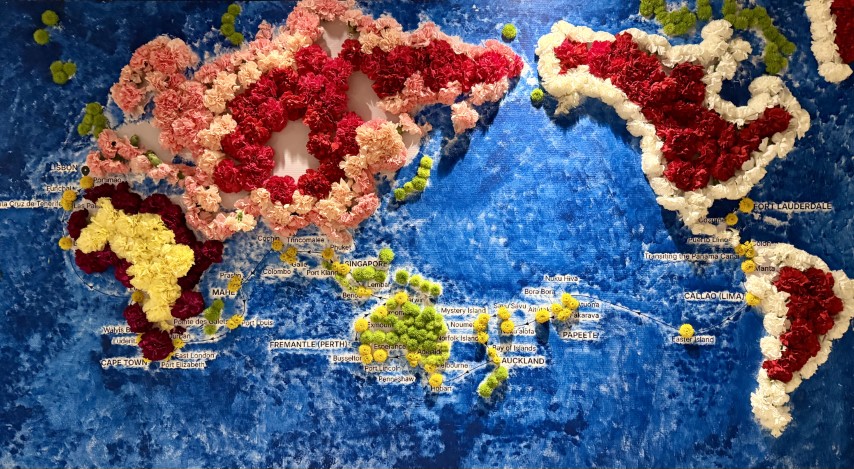
2026 World Cruise
January 6 - May 27, 2026
Enjoy travelling around the world
The oceans are always calling and looking to see who answers — and for many travelers, the ultimate answer is to take a cruise around the world. On Silversea’s World Cruise 2026, called “The Curious and the Sea: Discover How the World Was Discovered,” you can follow in the footsteps of historic explorers, becoming intimately acquainted with the primordial waters of the modern world and the stories behind each destination. Sailing on board Silver Dawn, guests will depart Fort Lauderdale on January 6, 2026, and arrive in Lisbon on May 27, 2026, recapturing the pioneering spirit of navigators from the past, exploring distant lands, diverse traditions, and delectable cuisine across six continents. The 140-day cruise calls at 58 ports in 30 countries.

Where in the World Are We?
We are in Ho Chi Minh City, Vietnam, in Southeast Asia.

HO CHI MINH CITY, VIETNAM
FORMERLY KNOWN AS SAIGON – THE ECONOMIC HEART OF VIETNAM
Ho Chi Minh City, also known as Saigon, has a rich and complex history that dates back centuries. The city has been
influenced by many different cultures and empires, including the Khmer, the Champa, the Chinese, and the
French, among others.
During the 19th century, Ho Chi Minh City became an important center for commerce and industry under French
colonial rule. The city underwent a period of rapid modernization and expansion, with new infrastructure and
buildings, including the iconic Notre Dame Cathedral and Central Post Office, built in the late 1800s.
During the 20th century, Ho Chi Minh City played a crucial role in the Vietnam War. In 1954, following the defeat of the
French at the Battle of Dien Bien Phu, the city became the capital of the Republic of Vietnam, supported by
the United States. The city was heavily bombed during the war, and many of its buildings were destroyed.
After the end of the war in 1975, Ho Chi Minh City became the capital of the Socialist Republic of Vietnam. The City
has since undergone a period of rapid development and growth, with new infrastructure, businesses, and tourist
attractions being built.
Today, Ho Chi Minh City is a bustling and cosmopolitan city home to over 8 million people. It is a hub of commerce, culture, and tourism, with a rich history and a bright future.
CU CHI TUNNELS
This vast 250-kilometer-plus network of tunnels served as the base for the Viet Cong’s military operations during the Vietnam War. Soldiers used the excruciatingly cramped tunnels as hiding places, hospitals, communication bases, supply routes, and even living quarters.
SIGHTS
Today, we traveled from Bangkok, Thailand, to Ho Chi Minh City, Vietnam


TONIGHT’S LOCAL SHOW – VAN ANH FUSION BAND
Van Anh Fusion is a Vietnamese folk fusion band formed in Ho Chi Minh City in 1996 under the name “Huong Sen” by artists Van Anh and Dru Nam while they were touring around the world.
Huong Sen changed its name to the “Van Anh Fusion” band in 2016, with 100 new members and over 20 years of growth.
VAF combines Vietnamese folk and modern music (rock, jazz, blues, country, etc.).
VAF manager is Ms. Van Anh – a director of Van Anh Event and a famous “Dan bau” (monochord) Artist from the South of Vietnam. The band leader is Mr. Dru Nam – an energetic drummer with many different playing styles and techniques
from folk to modern.


View a video of Mr. Dru Nam playing a bamboo percussion instrument.
View a video of Mr. Dru Nam playing a stone xylophone
View a video of a Vietnamese Hat Dance.
Dinner was in The Restaurant


Check out today’s Chronicle.

Where in the World Are We?
We left Paro, Bhutan, and flew to Bangkok, Thailand.

Today’s Excursions – We enjoyed a sumptuous Thai dinner and a classical dance performance at your hotel.
This evening, we concluded our seven-day overland excursion in grand style with a sumptuous Thai set menu dinner accompanied by a classical dance performance at the Shangri-La Hotel’s Salathip restaurant.


Check out today’s Chronicle.

Where in the World Are We?
We are in Paro, Bhutan, in the Himalayas in South East Asia

Today’s Excursion – Paro, Bhutan
National Museum, Farmhouse lunch, Paro Dzong, Farewell Bhutanese Dragon Tent Dinner and Dancers
We explored the kingdom’s rich culture and heritage at the National Museum of Paro, where an intriguing collection of artifacts provided an excellent introduction. Unfortunately, photos were not allowed inside the museum. The sections included paintings of different Buddhas, Mandellas (which show the way to Nirvana and Enlightenment), bronze statues, clothing from the ages, tools and farm implements, and weaponry. The museum’s purpose is to preserve Bhutan’s culture and heritage.


Tour the fortress of Paro Dzong, featured in Keanu Reeve’s film Little Buddha
Our tour continued with a visit to the Paro Dzong. Built to defend Paro from the Tibetan invasion, this fortress is also known as Rinpung Dzong, the ‘Fortress of a Heap of Jewels.’ This fine example of Bhutanese architecture now serves as the Paro District’s central monastic and administrative seat. In 1993, the Paro Dzong had its first Hollywood appearance when the Keanu Reeves film Little Buddha was partially filmed here.


Visit the local farmer’s market


Farmhouse Lunch
Our guide took us to a traditional farmhouse to enjoy a traditional lunch. He told us that 62% of Bhutanese are farmers. They raise their rice, vegetables, fruit, and livestock and are self-sufficient, leading a simple life. Plowing, planting, and growing crops were all manual or with a water buffalo. They had no running water, sat and slept on mats and cushions, and had one light bulb per room. They lived off the grid in a primitive, ancient civilization. Bhutan is the only country in the world that is carbon-positive. They have a model to follow if you want a green, carbon-neutral, positive environment.


FOREST & FORTRESS FAREWELL DINNER
Amidst the pine forest and the calming sounds of the brooks and streams flowing through the forest, we took this opportunity to dine under an intricately embroidered, traditional Bhutanese Ceremonial Tent. The Bhutanese Dragon tent is gently lit with stringed lights and numerous flickering lanterns across the forest. Warmth and ambiance are created with many candles and traditional Bhutanese music.
A traditional dance performance by a musical troupe with Amankora signature cocktails and canapés while enjoying a traditional Bhutanese dinner prepared by the in-house Bhutanese chef.


View a video of the farewell dinner dancers
Check out today’s Chronicle

Where in the World Are We?
We are in Paro, Bhutan, in the Himalayas in Southeast Asia.

Today’s Excursion – Eagle’s Nest
We drove to the base of Taktshang Goempa (Tiger’s Nest), one of Bhutan’s most revered monuments. It hangs off the face of a cliff approximately 2,950 feet above the valley floor. Legend states that Guru Rinpoche flew into Bhutan on a mythical tigress and meditated in a cave before bringing Buddhism to Bhutan. The Taktshang Goempa is built around the cave. The complete hike takes five hours. Sandy & I stopped about halfway due to the altitude and steep terrain. Our fifteen-year younger and better shape friends made the entire trip. They provided the closeup photos of the Eagle’s Nest.


View our friend’s video of their approach to the Eagle’s Nest.
https://www.youtube.com/shorts/9Gd5Zj1NvAA
View a video of the mountain stream at the Prayer Wheel Temple.
We dined on a private barbecue lunch in a lovely riverside meadow at the base of the Tiger’s Nest. Following our challenging hike to the most revered and iconic symbol of Bhutan, we proceeded for a private barbecue lunch in a lovely riverside meadow at the base of the Tiger’s Nest. Our Amankora Resort prepares a selection of grilled meats, vegetables, and other specialties, with a bar set up with our choice of refreshing beverages.


After lunch, we visited one of Bhutan’s oldest and most sacred temples in the Kingdom of Bhutan, the Jangtsa Dumtseg Lhakhang. The Tibetan saint Thangthong Gyelpo built the temple in 1421. It is the only temple in the form of a stupa.
At the temple, we lit 108 Butter Lamps, or karme, which represent the dispelling of the darkness of ignorance. Lighting butter lamps is an offering of light to the deities and is one of the most common means of increasing one’s merit. It also helps to focus the mind, aid meditation, and bring wisdom and compassion to our lives. Next, we went shopping in downtown Paro, returned to Amankora Resort, explored the area, and hiked to a nearby Dzong.


View a fast video overview of our Butter Lighting.
That evening, a Monk helped us make Prayer Flags with ink and a stencil.


Check out today’s Chronicle.

Where in the World Are We?
We are in Paro, Bhutan, located in Southeast Asia

About Paro
The beautiful valley of Paro encapsulates within itself a rich culture, scenic beauty, and hundreds of myths and legends. It is home to many of Bhutan’s oldest temples and monasteries, the National Museum, and the country’s only international airport. The approximately 23,996-foot-high Mount Chomolhari reigns in white glory at the valley’s northern end, and its glacial waters plunge through deep gorges to form the Paro Chhu (Paro River). Paro is also one of the most fertile valleys in the Kingdom, producing a bulk of the locally famous red rice from its terraced fields.
Today’s Excursion – Paro Festival and Paro highlights
The Paro Tshechu, or spring festival, is a five-day festival in Paro, Bhutan. The festival at Rinpung Dzong features masked dances, music, and other sacred rituals. Mask dances are performed inside the courtyard, and the courtyard outside the dzong hosts the festival the following days. Families attend in their best clothes.


Our next stop was a textile weaving where we saw the detailed hand weaving of colorful textiles. These complex patterns are passed down from generation to generation and are memorized by the women.


After the Festival, we checked into the Amankora Paro Resort and had dinner.


Join us on a tour of Amankora’s Paro Lodge, nestled within the pristine forests of Paro Valley, Bhutan. This remote sanctuary promises a unique cultural and wellness experience, allowing you to immerse yourself in the region’s profound spirituality. Discover once-in-a-lifetime adventures, such as hiking up to Tiger’s Nest or a breathtaking helicopter ride over the Himalayas, revealing sacred valleys, lakes, and awe-inspiring peaks.
Check out today’s Chronicle.

Where in the World Are We?
We traveled from Bangkok, Thailand, to Thimphu, Bhutan.

The Kingdom of Bhutan is small, landlocked country in South Asia. It’s located in the eastern Himalayas, between India and China. Bhutan is known for its monasteries, fortresses, and dramatic landscapes. Bhutan, a Buddhist kingdom on the Himalayas’ eastern edge, is known for its monasteries, fortresses (or dzongs), and dramatic landscapes that range from subtropical plains to steep mountains and valleys. Peaks such as 7,326m Jomolhari are popular trekking destinations in the High Himalayas. Paro Taktsang monastery (Tiger’s Nest) clings to cliffs above the forested Paro Valley.
With a population of over 727,145 and a territory of 14,824 sq miles, Bhutan ranks 133rd in land area and 160th in population. Bhutan is a constitutional monarchy with a king (Druk Gyalpo) as the head of state and a prime minister as the head of government. Vajrayana Buddhism is the state religion, and the Je Khenpo is the head of the state religion.
The Druk Gyalpo (Dragon King) is the head of state of the Kingdom of Bhutan. In the Dzongkha language, Bhutan is known as Drukyul, which translates as “The Land of the Thunder Dragon”. Thus, while the kings of Bhutan are known as Druk Gyalpo (“Dragon King”), the Bhutanese people call themselves the Drukpa, meaning “people of Druk (Bhutan)”.
The current sovereign of Bhutan is Jigme Khesar Namgyel Wangchuck, the fifth Druk Gyalpo. He wears the Raven Crown, the official crown worn by the kings of Bhutan. He is correctly styled “Mi’wang ‘Ngada Rinpoche” (“His Majesty”) and addressed “Ngada Rimboche” (“Your Majesty”).
Today’s Excursion – Thimphu, Bhutan
After breakfast at the hotel and check-out, transfer to the airport for your scheduled flight to Paro
After an 3 AM breakfast at the hotel and check-out, we met our guide and begin our fascinating trip to the Dagon Kingdom of Bhutan. We transfered to Bangkok Airport for check-in for our three-hour, 15-minute Drukair flight departing at 6:00 a.m. and arrived at Paro, Bhutan’s only international airport, at approximately 8:15 a.m. The flight into Paro is one of the most spectacular in the world. During our descent into this remote land, we experienced breathtaking panoramic vistas of the Himalayan peaks.


About Paro
The beautiful valley of Paro encapsulates within itself a rich culture, scenic beauty, and hundreds of myths and legends. It is home to many of Bhutan’s oldest temples and monasteries, the National Museum, and the country’s only international airport. The approximately 23,996-foot-high Mount Chomolhari reigns in white glory at the northern end of the valley, and its glacial waters plunge through deep gorges to form the Paro Chhu (Paro River). Paro is also one of the most fertile valleys in the Kingdom, producing a bulk of the locally famous red rice from its terraced fields.
Upon arrival in Paro, we met our guide and drove to the Amankora Resort in Thimphu for check-in and lunch.


About Thimphu
Nestled in a steep valley at approximately 7,709 feet, Thimphu is the capital of Bhutan and the center of government, religion, and commerce. This unique city is home to an eclectic blend of modern development alongside ancient traditions. Home to civil servants, expatriates, and a monk body, Thimphu maintains a strong national character in its architectural style.
We visited the Simtoka Dzong, built in 1629 by Zhabdrung Ngawang Namgyal, the first king who unified Bhutan. It functions as a monastic and administrative center and is the oldest dzong which has survived in its original form. Namgyal brought into vogue, for the first time in Bhutan, this concept of the “dzong” as castle monastery. We marvelled at its inspiring architecture and impressive location.


We continued to the Buddha Dordenma Statue, an enormous statue of Lord Buddha perched atop a hill and overlooking the entire Thimphu Valley. Great Buddha Dordenma is a gigantic Shakyamuni Buddha statue in the mountains of Bhutan celebrating the 60th anniversary of fourth king Jigme Singye Wangchuck. The statue houses over one hundred thousand smaller Buddha statues, each of which, like the Great Buddha Dordenma itself, are made of bronze and gilded in gold. The completed work is one of the largest Buddha rupas in the world, at 169 feet and contains 100,000 8-inch-tall and 25,000 12-inch-tall gilded bronze Buddhas. The statue was constructed at a cost of $47 million by Aerosun Corporation of Nanjing, China, which was sponsored by Rinchen Peter Teo a Singaporean businessman. The total cost of the entire project is well over $100 million.


Tour the Royal Takin Preservation Centre, a preserve for the national animal of Bhutan.
We tour the Royal Takin Preservation Centre. Originally a mini-zoo, it was converted into a preserve for the takin, the national animal of Bhutan (supposed to have the body of a cow and head of a goat). The Royal Takin Preservation Centre features a large area covered with pine forest.
We wnt to a local arts and craft market to see handmade goods. Dinner was at the Amankora Thimphu Resort.


Before dinner, a Buddhist Monk educated us about Bhutan’s version of Buddhism, which is based on serving others.

Check out today’s Chronicle.

Where in the World Are We?
Singapore is located in Southeast Asia.

SINGAPORE, SINGAPORE
DID YOU KNOW THE SURPRISING SUPERSTITIONS OF THE LION CITY?

Superstitions are like culinary specialties: every part of the world has its own, and discovering those new countries
is always an experience, if not tasty, then at least fun. Singapore is no exception to the rule in Southeast Asia that
gives pride of place to the supernatural and offers some surprising sparks of superstition that you can observe with a
smile or take home with you, should they bring you luck… You never know.
Let’s start with a belief that will please the cheapskates: you don’t give watches or shoes in Singapore. Watches
symbolize the end, and ‘giving a clock’ in Mandarin sounds similar to ‘attending a funeral.’ To avoid bringing death,
no watches or clocks are given. For shoes, the same battle: the shoe is pronounced the same way as evil in Mandarin. So
it’s in awful taste to give shoes. Two beliefs that can save a lot of money…
Cutting your nails after dark is also forbidden. In Singapore, this practice is believed to attract angry spirits who
could bring misfortune to the house and its inhabitants. Never point at the moon, either, especially a full moon. The risk?
Finding yourself with the tips of your ears cut off in your sleep. Also to be avoided is whistling at night. This practice,
which is harmless everywhere else, seems to please ghosts in this part of the world. Whistle at night, and you could
end up with a string of not-always-benevolent ghosts hanging around your neck. Fortunately, the best way to deal with
this is to wash your feet and face when you get home to ward off the wandering spirits.
Another rule of the Lion City, also found in Vietnam, is that you don’t take photos of three people. Two, yes.
Four, yes, but three, no. It’s bad luck for the person in the middle to be the first to die.
Finally, let’s finish with a rather amusing and intriguing superstition involving new owners, a new flat or house, and
a pineapple. For good fortune to fall upon a new house and its owners or occupants, when they first enter their new
home, they must knock on the door three times and shout ‘huat ah’ (good luck) as they roll a pineapple around.
Derived from Feng Shui, this practice is said to purify the premises. The story doesn’t say, however, whether a tin of
pineapples will do the trick…
SIGHTS
CLOUD FOREST
This magnificent greenhouse-like glass dome can be seen from miles away and is just as stunning inside as it is from out. Home to one of the world’s tallest indoor waterfalls and a lush mountain clad with plants from around the world, Cloud Forest rewards the curious and adventurous. Go on a fascinating journey of discovery and get up close with some of the world’s most exotic plant species as you stroll along its unique aerial walkways.

Today’s Excursion – Singapore Local Experience
Singapore is well-known for its bustling activity along its streets and waterfront. We explored the sights and sounds up close as we ran around on the city’s different forms of transportation: river boats, MRT (Subway), and trishaws. We departed the pier on foot with your guide. Our guide led us through the city with a Singapore survival kit of essential items like a map, coins for the subway, mineral water, tiger balm ointment, and a sandalwood fan.
City Highlights
We explored Chinatown, where the streets are lined with century-old shophouses that sell food and trinkets. We strolled along Pagoda Street and saw the Chinese-influenced trinkets, accessories, apparel, and more.
We viewed the Buddha Tooth Relic Temple and Museum and the Sri Mariamman Temple, which dates back to 1827 and is the oldest Hindu temple in Singapore.


Check out today’s Chronicle.

Where in the World Are We?
Singapore is the City Nation at the end of Malaysia in Southeast Asia.

SINGAPORE, SINGAPORE
EXPLORE AN EXCITING MELTING POT OF CULTURE AND HISTORY
Advanced, airy, and elevated Singapore is a spectacular futuristic vision of utopian city life. A healthy population of
almost six million calls it home. Still, this city is designed with space to breathe and gorgeous outdoor parks, massive
indoor greenhouses, and beautiful recreational spaces spread between the City of Gardens’ skyscrapers and soaring
structures. Glorious fountains and audacious skyscrapers loom up – nodding to traditional feng shui beliefs – and
putting on dazzling illuminated displays after dark.
The lush green botanical gardens are a spectacular UNESCO World Heritage Site covering 52 hectares and decorated
with impressive colorful orchids. Or breathe in the freshest air by wandering the canopy-strung bridges of MacRitchie Reservoir Park.
Head for the iconic Marina Bay – a landmark of the city crowned by three interconnected towers that watch out
over island-sprinkled waters. Jaunt between Little India and the atmospheric Chinatown in minutes, where beautiful
temples – like the Chinese Thian Hock Keng Temple and Hindu Sri Mariamman Temple add rich cultural intrigue.
Singapore’s cuisine is a mouthwatering fusion of Indian, Chinese, Indonesian, and Malay influences, which take and enhance
GARDENS BY THE BAY
Explore this beautifully designed green space and wander through the Bay East Garden, perfect for enjoying the vibrant plant life and escaping the bustling city momentarily. Visit the Supertree Grove, a cluster of iconic, futuristic structures designed to perform environmentally sustainable functions, and the world’s tallest indoor waterfall in the Cloud Forest Dome.
SIGHTS
Today’s activities included:
Bridge
Tonight’s dinner was at The Restaurant


Today’s Excursion – Mesmerizing Singapore By Night
We discovered beautiful Singapore by night during this scenic sightseeing journey by cable car, bus, and riverboat.
Singapore, Cable Car Station & Ride, Sentosa Island, Wings of Time
We departed the pier for a short walk to the Cable Car Station on Sentosa Island and back to the Cable Car Station. We boarded transportation and drove to Sentosa Island, where we saw the spectacular, award-winning outdoor night show Wings of Time. This epic tale of courage, mystery, and magic held us spellbound while taking us on a magical adventure through several exotic vistas via the fabric of time. We were mesmerized by awe-inspiring displays of water, lasers, fire effects, and music.


Coach Bay, Clarke Quay, Riverboat-Cruise, Singapore River, Merlion Park & Statue, Marina Bay
After the show, we returned to nearby Coach Bay, where we transferred to Clarke Quay, a vibrantly orchestrated and delightful blend of modern and traditional architecture that reflects Singapore’s rich heritage. We embarked on a riverboat for a scenic, 30-minute cruise down the Singapore River. Along the way, we saw the skyline of the Singapore Commercial District and passed by iconic sites like Merlion Park, where a half-fish, half-lion statue spouts water from its mouth, 28 feet tall and weighs 77 tons. We marveled at the expansive Marina Bay area, with its architectural icons dotting the impressive skyline.
Fullerton Bay Hotel, Cocktail, City Skyline, 360-Degree Views
After disembarking our riverboat, we walked to the nearby Fullerton Bay Hotel, offering the best views of Singapore’s city skyline. We relaxed with a cocktail and enjoyed our surroundings’ breathtaking vistas and photo opportunities.


Check out today’s Chronicle.

Where in the World Are We?
Sailing from Semarang, Indonesia, to Singapore.

Today’s activities included:
Enrichment Lecture with World Affairs Lecturer Marc Ginsberg
Taiwan Tensions:
Will China’s President Xi Attempt to Take Taiwan by Force?
Count China’s threats against Taiwan as the greatest threat to world peace.
How will the U.S. and its Asia-Pacific allies respond?


Tonight’s dinner was in The Restaurant.


TONIGHT’S SHOW – VIRTUOSO VIOLINIST JAKUB TRASAK
Jakub Trasak is among his generation’s most talented and versatile violin players and producers. He began performing at the age of three, and his career includes more than 30 prime television appearances and live shows in venues such as Carnegie Hall, Boston Symphony Hall, and the Kennedy Center. He grew up in the Czech Republic and graduated from Prague Conservatory and Berklee College of Music.
Jakub is famous for keeping audiences emotionally engaged and on the edge
of their seats by showcasing authentic and exciting performances across a wide range of musical genres
Check out today’s Chronicle.

Where in the World Are We?
We toured the Mangarakan Royal Palace in Surakarta, Central Java, Indonesia. (Near Semarang)

SEMARANG, JAVA, INDONESIA
INDONESIA – AN ARCHIPELAGO OF 17,508 ISLANDS AND A LANGUAGE RICH IN HISTORY
The island of Java is home to a large number of ethnic groups, all of whom have preserved the richness of their
language while also speaking the country’s official language, Indonesian.
Basa Jawa, or Javanese, is the language of the Javanese ethnic people. But unlike most other languages, there is not
one, but three very distinct Javanese dialects, the use of which is highly codified: Kromo, Madhjo, and Nyoko.
The idiom used is dictated by each speaker’s age and social background. For example, when speaking to
someone important – or more important than oneself – or when you want to show appreciation to the other person,
you use Kromo, the High Javanese or court language used to express deference and respect. To express yourself as an
equal, you use Madhjo; to speak to someone of lower rank, you use the popular language, Nyoko.
Complicated? Indeed, but the complexity of Basa Jawa does not stop there. This triple language also has
variants depending on the region of the island where the speakers live: Basa-Dalam in the central areas in the
island, Basa-Luar for the coastal dialect, and in the western mountains, Soenda, which is even an independent idiom
of Javanese.
Conjugation? Piece of cake… As the language has neither article nor gender and only two numbers, conjugation
logically makes no distinction between numbers or persons, and to top it all off, the same word can be both verb and
noun. Add to this the fact that words that can be combined to form compound words transform that
make them unrecognizable, and you have a language that is fascinating for a linguist to study but that would give
any language student terrible nightmares.
The icing on the cake? Javanese uses an alphabet derived from an ancient Indian alphabet. And if you’re wondering
whether this rich language has anything to do with computer languages, you should know it does not. The Java
language was named by its creators after… coffee, java being the nickname sometimes given to a cup of
coffee in the United States.
PASAR JOHAR SEMARANG
Johar Market in the heart of Semarang is one of the historical buildings inaugurated on June 9, 1939. It is considered one of South East Asia’s biggest and most modern markets. This historic market has been a cultural and economic center for generations, and its rich history, incredible variety of goods, and lively atmosphere make it a must-visit destination for locals
and tourists alike.
SIGHTS
Today’s Excursion – Day 2 of “Where Majestic Temples Meet.
Mangarakan Royal Palace
The Pura Mangkunegaran is a Surakarta, Central Java, Indonesia palace complex. It is the official palace and residence of the Duke of Mangkunegara and his family. The palace complex is one of the centers of Javanese culture and contains a museum exhibiting royal artifacts of Mangkunegaran. We had performances of “Women Coming of Age” and “Men in Military Training.:


After the tour and performances, we had lunch in a glass pavilion.


TONIGHT’S SHOW WITH JULIAN GARGIULO
PIANIST WITH THE HAIR
Julian Gargiulo is a pianist, composer, and Steinway Artist. He performs regularly
in Carnegie Hall, United Nations, Moscow Conservatory Hall, Symphony Stage in
Singapore, and Seymour Theatre in Sydney, and has been featured on Radio and
TV stations in North America, Europe, and Asia. His first recording for Deutsche
Grammophon “Estro,” with violinist María Dueñas, was released earlier this year
to wide acclaim.
Julian’s concerts are always an interactive experience. Julian. He captivates his audience with his technical precision and Jerry Seinfeld-ish wit. Julian invites his audience to abandon all preconceived notions about classical concerts. He presents a program on stage that includes classical standards, Tango transcriptions, and his compositions. He engages the audience in between pieces by sharing his personal stories, anecdotes from composers’ lives, and his home remedies for jet lag.
In 2015, Julian presented the first edition of ‘Getting to Carnegie’, an international music competition that offers musicians worldwide a chance to share the stage at Carnegie Hall. In 2020 Julian and his wife Elektra started a New Music Series called “One Classical Minute” (www.oneclassicalminute.com) described as “High Culture in Low Doses” for everything you never wanted to know about classical music, and never bothered to ask.
Julian splits his time between New York and Paris. More info at: www.pianistwiththehair.com
“Saturday Night Live meets Carnegie Hall” (Huffington Post)
“Expect to revise any preconceived notions you have about classical music concerts.” (Huffington Post)
“He’s the only classical musician I know who could truly be regarded as a rock star as well.” (The Courier Mail)
“He was in town last night… he’s just brilliant… there are not enough words to describe the genius behind him because when he sits down and plays, you are watching a Beethoven or Chopin… years from now, your grandkids and great-grandkids will be talking about Julian. He’s just magnificent.” (ABC TV)


Tonight’s dinner was in The Restaurant.


Check out today’s Chronicle.